
Ace the Shorter GRE: Your 10-Week Self-Study Plan (Optimized for Efficiency)
- GRE Black Book

- Nov 3, 2025
- 3 min read
The Graduate Record Examination (GRE) is now shorter, clocking in at under two hours. While the content remains the same (minus the "Analyze an Argument" essay), the condensed format means every question carries more weight. This makes having a strategic GRE study plan more critical than ever.
Forget expensive courses—this comprehensive, 10-week GRE self-study schedule is designed to guide you from diagnostic test to test day, focusing on high-yield concepts and maximizing your score potential. If you're looking for a focused GRE crash course timeline, this structured, two-and-a-half-month approach is your answer.

Phase 1: Foundation and Diagnostics (Weeks 1–2)
The goal of this phase is to establish your baseline and build the core knowledge required for both Verbal and Quantitative sections.
Week | Focus Area | Key Activities & Goals |
|---|---|---|
Week 1 | Diagnosis & Vocabulary | Diagnostic Test: Take a full-length, timed practice test (ETS PowerPrep recommended) under simulated conditions. This establishes your baseline and flags immediate weaknesses. Error Log: Start an "Error Log" spreadsheet to track every mistake. Vocabulary: Start memorizing high-frequency words (aim for 100-150 words this week). Prep Setup: Gather essential materials (ETS Official Guide, dedicated prep book, flashcards). |
Week 2 | Quant Fundamentals | Arithmetic Review: Review number properties, percentages, ratios, and algebraic operations. Focus heavily on Quantitative Comparison strategies. Verbal Practice: Drill 20 Text Completion (TC) and Sentence Equivalence (SE) questions daily, focusing on the vocabulary context. Review: Spend 30 minutes reviewing the mistakes from your diagnostic test, focusing on why the errors occurred. |
Phase 2: Content Mastery (Weeks 3–6)
This is the deep-dive period where you systematically conquer the core content areas, alternating focus between Quant and Verbal.
Week | Focus Area | Key Activities & Goals |
|---|---|---|
Week 3 | Quant: Geometry & Algebra | Geometry: Review lines, angles, triangles, polygons, and circles. Master coordinate geometry concepts. Algebra: Focus on exponents, roots, linear equations, and inequalities. Vocabulary: Continue daily vocabulary reviews and incorporate a few words into your essay practice. |
Week 4 | Verbal: Reading Comprehension | Strategy Focus: Learn and practice strategies for short, medium, and long Reading Comprehension (RC) passages. Focus on identifying the main idea and the author's tone. Practice Test: Take your Second Full-Length Practice Test. Review results and update your Error Log immediately. |
Week 5 | Quant: Data Analysis | High-Yield Topics: Master statistics (mean, median, mode, standard deviation, distribution) and probability. These topics are highly tested. Data Interpretation: Practice solving multi-part questions based on graphs, tables, and charts. AWA:Complete one timed "Analyze an Issue" essay using official prompts. |
Week 6 | Verbal: Advanced Strategies | Text Completion (Advanced): Focus on sentence structure, transition words, and double- and triple-blank questions. Sentence Equivalence: Practice identifying synonyms and the overall sentence meaning. Review: Spend a full day reviewing your entire Quant error log from Phases 1 and 2. |
Phase 3: Pacing and Simulation (Weeks 7–10)
The final phase shifts from learning content to mastering the test format, pacing, and endurance—the true essence of a successful GRE crash course.
Week | Focus Area | Key Activities & Goals |
|---|---|---|
Week 7 | Integration & Pacing | Third Full-Length Practice Test: Take it on a Saturday morning at the same time as your actual test to build endurance. Targeted Drills: Dedicate all week to only drilling questions from your weakest areas identified in the Error Log (e.g., if you struggle with quantitative comparison, do 40 QC questions per day). Vocabulary: Perform an entire review of all vocabulary words learned. |
Week 8 | Strategy Optimization | Pacing Review: Review the time taken per question type. Are you spending too long on RC or data analysis? Adjust your in-test strategy. Mental Math: Practice mental shortcuts, estimation, and using the on-screen calculator efficiently. AWA:Complete a final timed "Analyze an Issue" essay and self-score it. |
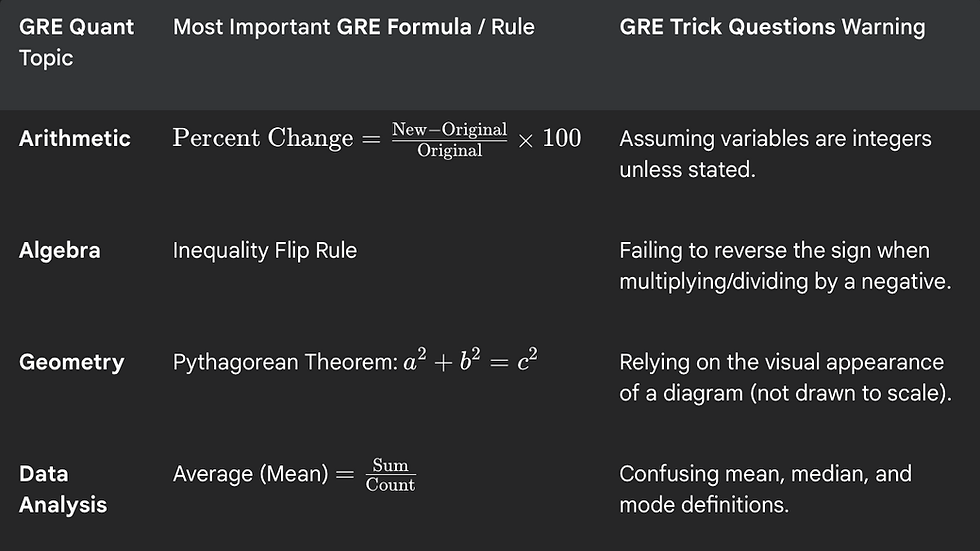
Week 9 | Full Simulation | Fourth Full-Length Practice Test: Take the last full-length simulation. Mimic Test Day: Wear the clothes you plan to wear, use the same desk, and have your water ready. Final Review: Update your Error Log one last time. Create a single-page "Formula Cheat Sheet" for quick review. |
Week 10 | Taper and Test Day | Days 1-5 (Tapering): Light review only—flashcards, skimming your formula sheet, and reviewing your error log. STOP taking new practice tests. You are ready! Test Day Prep: Confirm your test center location and required documents. Get plenty of sleep. Day 6 (Test Day): Execute your plan! |
Maximize Your Self-Study Success: Quick Tips
Prioritize Official Material: The official ETS PowerPrep tests and guides are the most accurate source of practice questions.
The Error Log is Gold: Tracking your mistakes helps you study smarter, not just harder. For the shorter test, avoiding repeat errors is paramount.
Consistency Over Intensity: Stick to your weekly study hours (aim for 10–15 hours per week) rather than sporadic all-day cramming sessions.


Comments