
GRE Quant Overview: Mastering Algebra, Formula, and Avoiding Trick Questions
- GRE Black Book

- Nov 3, 2025
- 3 min read
The Quantitative Reasoning section of the GRE is designed to test your application of high-school level mathematics, but it often utilizes sophisticated language to disguise simple concepts. A high score on GRE Quant is less about advanced math and more about strategic problem-solving.
To succeed, you must master the four main content areas and be hyper-aware of the common GRE trick questionsembedded within.
1. Arithmetic & Number Properties: The GRE Trick Questions Hub
Arithmetic covers foundational concepts like integers, fractions, decimals, percentages, and ratios. While the concepts are basic, this section is a frequent source of GRE trick questions because it preys on assumptions.
Key Topics: Divisibility, Remainders, Prime Numbers, and Exponents.
The Big Trap (Assumption): Never assume a variable represents an integer. If the problem states: "If x^2 = 9, what is x?", you must consider both x=3 and x=-3. If the question asks, "If x^2 = 9, what is the area of a square with side length x?", only then can you assume x is positive.
Formula Focus: While minimal, memorize the rules for finding the sum of evenly spaced sets (e.g., consecutive integers).
2. GRE Algebra: The Core GRE Formula Repository
GRE algebra forms the most substantial component of the exam. Mastery here means internalizing the core GRE formula and knowing when to use substitution over brute-force solving.
Linear and Quadratic Equations: Be fluent in solving for x in single-variable equations, systems of two variables, and quadratic equations (e.g., x^2 + 7x + 12 = 0).
Exponents and Radicals: Your fluency in exponent rules, such as x^a * x^b = x^{a+b} and the power rule (x^a)^b = x^{ab}, will save valuable time.
Inequalities and Absolute Value: This is a major source of GRE trick questions. The most critical GRE formulaprinciple here is the Inequality Flip Rule: You must reverse the inequality sign when multiplying or dividing both sides by a negative number.
Word Problems: The trick is in the translation. Practice converting complicated sentences about rates, mixtures, or ages into clear algebraic expressions.
3. Geometry: Visual Traps and Essential GRE Formula
The GRE Quant geometry questions require memorization of fundamental shapes and formulas.
Key Topics: Triangles (Pythagorean Theorem, special right triangles 30-60-90 and 45-45-90), Circles, Quadrilaterals, and Volume/Surface Area of 3D objects.
The Big Trap (Visual): NEVER trust a figure is drawn to scale unless explicitly stated. This is a classic GRE trick questions device, especially in Quantitative Comparison. You must rely solely on the geometric principles or the values given.
Formula Focus: Have instantaneous recall of the area GRE formula for circles, triangles, and parallelograms.
4. Data Analysis, Probability, and Counting
This category requires both mathematical understanding and critical reading skills.
Key Topics (Statistics): Mean (Average), Median, Mode, Range, and Standard Deviation.
The Big Trap (Weighted Average): Avoid simple averaging when dealing with groups of unequal size. You must calculate the total sum of all values before dividing by the total count.
Counting Methods: For problems involving Permutations and Combinations, the real difficulty lies in knowing which GRE formula to apply (order matters for permutations; order does not matter for combinations).
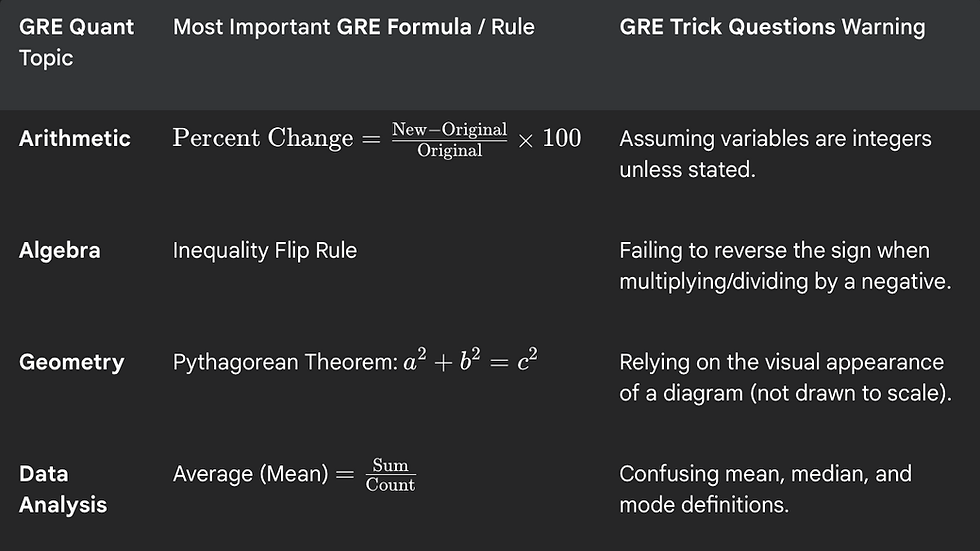
To maximize your score on the GRE Quant section, dedicate practice time specifically to analyzing the question types where GRE trick questions are prevalent. Knowing the math is step one; knowing the traps is how you score 170.


Comments