
Decoding GRE Quant Algebra: Mastering the GRE Function Formula and Sequence Questions

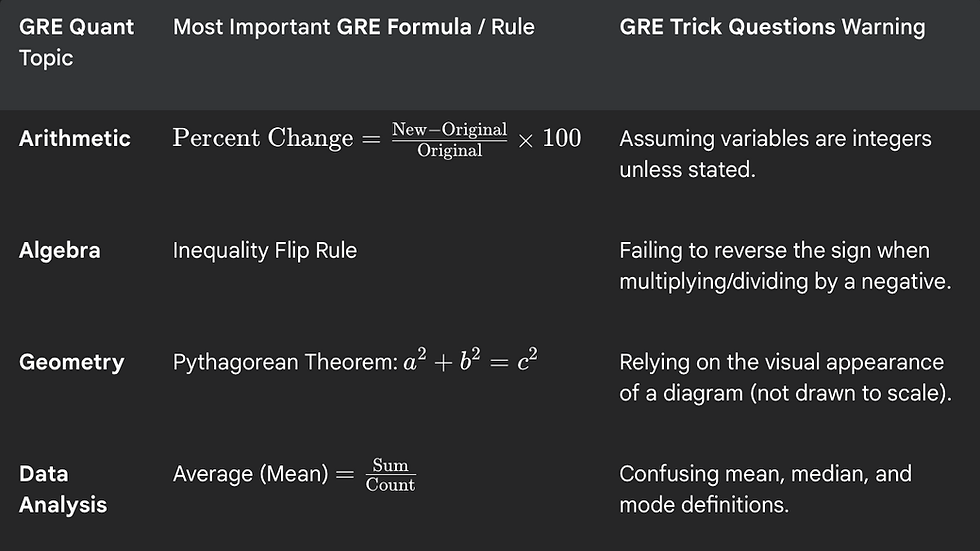
The new GRE is shorter, faster, and requires peak concentration for its full 1 hour and 58 minutes. While the time pressure has changed, the core content of the GRE Quant section—covering Arithmetic, Algebra, Geometry, and Data Analysis—remains the same.
One area where students often stumble is Algebra, specifically questions involving functions, recursive formula, and numerical sequences. These questions test not just calculation, but your ability to translate abstract rules into concrete numbers.
Here’s your expert guide to mastering the algebraic concepts that frequently appear in the Quantitative sections.
1. Navigating Functions and Formulas
Function questions on the new GRE are typically less about advanced calculus and more about testing basic substitution and interpretation. A function is essentially a rule that assigns exactly one output value (often $f(x)$) for every input value ($x$).
Key Function Types and Strategies:
Type | Example | Core Strategy |
|---|---|---|
Substitution | If f(x) = 2x^2 - 3, find f(4). | Substitute the input value directly into the formula. |
Composite Functions | If f(x) = x+1 and g(x) = x^2, find f(g(2)). | Work from the inside out: First find $g(2)$, then use that result as the input for $f(x)$. |
Defined Operations | Let x * y = 2x + y. Find 3 * 5. | Treat the symbol (*) as a set of instructions. Substitute the values and follow the order of operations. |
Domain & Range | What values of x (domain) will result in a real number? | Look for restrictions: division by zero (denominator cannot be 0) and square roots of negative numbers. |
Expert Tip: Many GRE Quant function questions can be solved by "plugging in" simple integers or by testing the boundaries of the domain and range, especially in Quantitative Comparison questions.
2. Deciphering GRE Function Formula in Sequences
Sequence problems are a blend of arithmetic and formula application. A sequence is an ordered list of numbers (terms) that often follows a pattern. The two main types you'll encounter rely heavily on formulas:
A. Arithmetic Sequences (Linear Patterns)
In an arithmetic sequence, the difference between consecutive terms is constant (the "common difference," d).
Example: 2, 5, 8, 11, (Here, d = 3)
Formula (The n-th term): a_n = a_1 + (n-1)d
Strategy: You might be asked to find a missing term or a specific term far down the line. Use the formula to quickly jump to the required position without listing every term.
B. Geometric Sequences (Exponential Patterns)
In a geometric sequence, the ratio between consecutive terms is constant (the "common ratio," r).
Example: 3, 6, 12, 24, (Here, r = 2)
Formula (The n-th term): a_n = a_1 x r^{n-1}
Strategy: These grow very fast. You must use the exponent rule to solve them efficiently. The GRE Quant often tests your ability to find a ratio or the first term, given two non-consecutive terms.
C. Recursive Sequences (The Tricky Ones)
A recursive sequence defines the next term based on one or more previous terms, rather than directly based on its position (n).
Example: a_n = a_{n-1} + a_{n-2} (This is the Fibonacci sequence formula!)
Strategy: The only way to solve these is to list out the first few terms. If the question asks for the 100th term, look for a repeating pattern in the first 5 or 6 terms (a cycle). If you find a cycle, you can use the remainder of a division problem to find the 100th term without calculation.
GRE Function Formula Key Takeaway for the New GRE
The shortened new GRE means every question counts more. For GRE Quant, a strong grasp of these algebraic formulaand function concepts is essential for maximizing your score. Focus your practice not just on solving the problem, but on identifying the fastest formula or substitution method available.


Comments