
ALGEBRA'S EDGE: MASTERING THE TRICKY TOPICS ON GRE QUANT
- GRE Black Book

- Nov 3, 2025
- 3 min read
The GRE Quant section is a critical hurdle for graduate school applicants, and within it, GRE algebra forms the foundational bedrock. While the most recent format of the GRE is shorter, the depth and complexity of the algebra tested remain high. To achieve a top score, you need more than simple variable manipulation—you need a strategic approach to the trickiest problem types.
Here is an essential guide to the major GRE algebra topics and the common pitfalls test-takers face.
Core Pillars of GRE Quant Algebra
Most GRE Quant algebra questions fall into these four fundamental categories:
1. Linear and Simultaneous Equations
This is the "bread and butter" of GRE algebra. You must be proficient in solving for one variable (e.g., 3x + 5 = 14) and solving systems of two variables (e.g., 2x + y = 7 and x - y = 5).
Strategy: Master both the Substitution Method and the Elimination Method for simultaneous equations. Often, the context of the question (especially in Quantitative Comparison) will dictate which method is faster.
2. Quadratic Equations
Quadratic equations (those involving an x^2 term, typically in the form ax^2 + bx + c = 0) are highly tested.
Key Skills:
Factoring: Being able to quickly factor trinomials (e.g., x^2 + 5x + 6) into binomials is the most time-efficient method.
The Quadratic Formula: Know the Discriminant formula as a reliable backup when factoring is difficult or impossible.
Algebraic Identities: Memorize and apply identities like the difference of squares: a^2 - b^2 = (a+b)(a-b). This identity can often simplify complex expressions instantly.
3. Exponents and Radicals
The GRE tests your knowledge of the fundamental rules of exponents and their inverse, radicals (roots).
Must-Know Rules:
Product Rule: x^a * x^b = x^{a+b}
Quotient Rule: {x^a}/{x^b} = x^{a-b}
Power Rule: (x^a)^b = x^{ab}
Tricky Application: Be comfortable converting radicals to fractional exponents
The Tricky Territory: Inequalities and Absolute Value
While solving equations is straightforward, inequalities introduce a critical rule that trips up many test-takers, making them one of the trickiest GRE Quant topics.
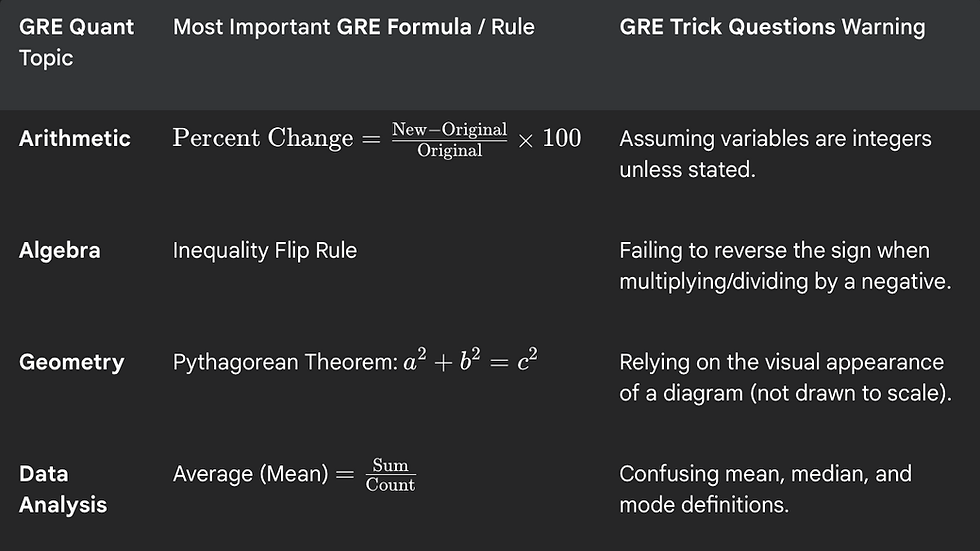
The Inequality Flip Rule
The absolute most crucial rule to remember when solving any GRE algebra inequality is this:
When you multiply or divide both sides of an inequality by a negative number, you MUST reverse (flip) the inequality sign.
Example of the Pitfall: If you start with: -2x < 6 You must divide by -2 and flip the sign: x > -3
Failing to flip the sign is one of the most common errors.
Quadratic Inequalities
Questions involving quadratic inequalities (e.g., x^2 - 4x + 3 > 0) require an extra step:
Factor the quadratic: (x-1)(x-3) > 0.
Find the roots (where the expression equals zero): x = 1 and x = 3.
Use a number line to test regions and determine the range of x values that satisfy the inequality.
Absolute Value
Absolute value expressions (e.g., |x - 5| = 3) always generate two cases because the value inside the bars can be positive or negative.
Rule: If |A| = B, then A = B OR A = -B.
Example: For |x - 5| = 3, the solutions are x - 5 = 3 (so x = 8) OR x - 5 = -3 (so x = 2).
Word Problems: Translating English to GRE Algebra
The most difficult GRE Quant questions often mask these algebraic concepts inside verbose word problems. Mastery here means mastering translation.
English Phrase | Algebraic Translation |
|---|---|
"Four less than three times x" | 3x - 4 |
"The ratio of A to B is 3 to 5" | A/B = 3/5 |
"Five consecutive integers" | n, n+1, n+2, n+3, n+4 |
"The sum of the squares of x and y" | x^2 + y^2 |
The key to succeeding with GRE algebra word problems is to assign variables clearly and convert the entire prompt into an equation or inequality before you start solving.
By reinforcing these foundational GRE algebra rules and focusing on the critical exceptions (like the inequality flip), you will be well-equipped to maximize your score in the GRE Quant section.


Comments